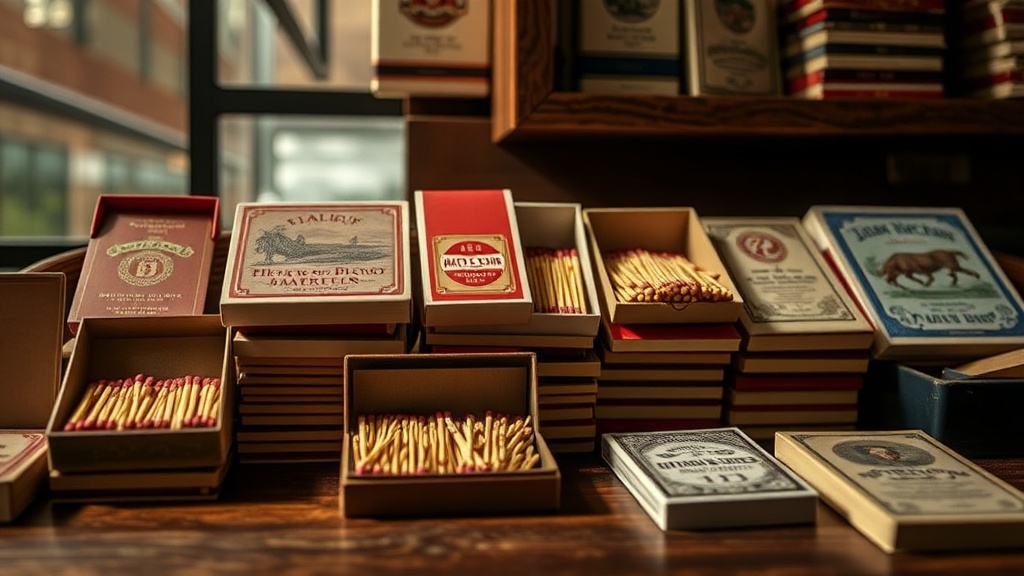
How to Photograph Your Matchbook Collection for Online Sales and Insurance

Most collectors believe expensive camera equipment makes the difference between a matchbook photo that sells and one that sits ignored. That's backwards—lighting and positioning matter far more than megapixels. Whether you're documenting a collection for insurance, preparing eBay listings, or sharing finds with online communities, the right approach transforms amateur snapshots into professional-grade images that protect your investment and attract serious buyers.
Why Do My Matchbook Photos Look Washed Out?
The culprit is almost always your light source. Overhead room lighting creates harsh shadows and yellow color casts that obscure strike pad texture and foil stamping details. Natural window light works better—but only at specific times and from specific angles. Place your matchbook perpendicular to the window, not directly facing it. Morning light (roughly 9–11 AM) provides soft, diffused illumination without the harsh midday glare that blows out white paper stocks.
You'll need a simple setup: a white foam board as your base, a second board to bounce light back onto shadowed areas, and something to hold your phone or camera steady. No tripod? Stack books. The goal is eliminating camera shake while keeping the matchbook flat and parallel to your lens. Shooting at a slight angle distorts the rectangular shape—buyers notice immediately and trust the seller less.
White balance confuses most beginners. Your camera guesses at color temperature, and it's usually wrong under artificial light. Set it manually to 5500K (daylight) if your camera allows, or use a gray card for reference. Smartphone users should tap the screen to focus, then swipe to adjust exposure until the white paper looks white—not gray, not cream, not bluish. Those subtle color shifts make vintage matchbooks look either artificially aged or suspiciously bright.
What's the Best Way to Show Strike Pad Condition?
The strike pad tells experienced collectors everything—how much use the matchbook saw, whether it was carried in pockets, and whether matches were actually struck. Yet most sellers photograph only the front cover, hiding this critical detail. Always shoot three angles: front cover at straight-on perspective, back showing the strike pad close-up, and a slight overhead view revealing the matchbook's profile (thickness and whether matches remain).
Macro mode matters here. Modern phones activate close-focus automatically when you bring the lens near the subject. For dedicated cameras, a 50mm lens with extension tubes costs under $30 and delivers professional magnification. You want to show fiber texture in the strike paper—smooth pads suggest light use or replacements, while rough, darkened areas indicate authentic age. Capture these at f/8 or f/11 for sufficient depth of field; wide apertures like f/2.8 blur half the strike pad.
Scale references prevent disputes. Place a ruler or coin beside the matchbook in at least one frame. The National Institutes of Health provides free downloadable millimeter scales specifically for documentation photography. Buyers can't claim "it looked bigger in the photo" when you've provided objective measurement, and insurance adjusters appreciate the diligence if you ever file a claim for fire or water damage.
How Should I Edit Photos Without Misrepresenting the Item?
Heavy editing destroys trust in collecting communities. Brightness and contrast adjustments are fine—color manipulation crosses ethical lines. That faded red cover shouldn't become vibrant crimson just because you adjusted saturation. Your goal is accurate representation of what arrives in the buyer's mailbox, not Instagram-worthy aesthetics.
Use free software like GIMP or paid options like Lightroom, but limit yourself to four adjustments: exposure correction (making the image neither too dark nor blown out), slight contrast increase for readability, sharpening (but only after resizing), and spot removal for dust particles that weren't on the actual matchbook. Never clone out creases, stains, or tears. Documentary photography serves collecting communities; deception undermines them.
File naming conventions protect your organization. Use format: YYYY-MM-DD_Brand_Location_Condition.jpg. This creates automatic chronological sorting while making specific items searchable without opening files. Back up originals separately from edited versions—insurance companies may request unprocessed documentation to verify authenticity. The Library of Congress preservation guidelines recommend uncompressed TIFF archives for valuable collections, with JPEGs derived for everyday use.
Where Should You Share These Images?
Facebook groups and Reddit communities have different standards than auction platforms. r/matchboxcollectors (which also welcomes matchbooks) prefers single high-resolution images with descriptive titles. eBay allows twelve photos per listing—use all of them. Show the matchbook sealed in a archival sleeve, removed from the sleeve, and any manufacturing marks on the inside fold that reveal printer information.
Your own digital archive matters as much as public sharing. Cloud storage is convenient but vulnerable—maintain local backups on external drives. Organize folders by decade, then state, then brand. This mirrors how most serious collectors mentally catalogue their holdings and makes retrieval painless when someone asks, "Do you have any 1940s Oregon restaurant matchbooks?"
Consider metadata embedding. EXIF data should include date photographed, your copyright, and keywords like "vintage matchbook" and "Portland collecting." Software like ExifTool batch-processes entire folders. This invisible information travels with the image, establishing provenance if your photos circulate uncredited and improving search visibility on platforms that index metadata.
Common Mistakes That Damage Your Reputation
Flash photography is the cardinal sin. Direct flash eliminates shadow detail, creates hot spots on glossy covers, and announces amateur status. If you must shoot at night, bounce the flash off a white ceiling or use a diffusion panel. Better yet—don't shoot at night. Matchbooks have waited decades; they can wait for Saturday morning's window light.
Another error is photographing through plastic sleeves. The glare and softening obscure condition details that determine value. Remove matchbooks from protective storage for photography, then return them immediately. Yes, it's tedious. Yes, it's necessary. Buyers paying premium prices for mint condition items deserve to see that condition unfiltered by PVC or polyethylene barriers.
Cropping too tightly eliminates context. Leave enough background to prove you haven't digitally altered edges or hidden damage. A quarter-inch margin on all sides provides breathing room without distracting from the subject. Consistent framing across your collection also creates visual coherence when displaying multiple items—important for collectors building Instagram followings or personal websites that showcase their holdings.
Finally, photograph immediately upon acquisition. Memory fades, provenance details blur, and you'll forget whether that 1950s motel matchbook came from the estate sale or the flea market. One photo session during intake—before items enter storage—creates permanent documentation that appreciates in value as your collection grows and individual pieces become harder to replace.